Yelly Writes

Stop outsourcing your self-worth!

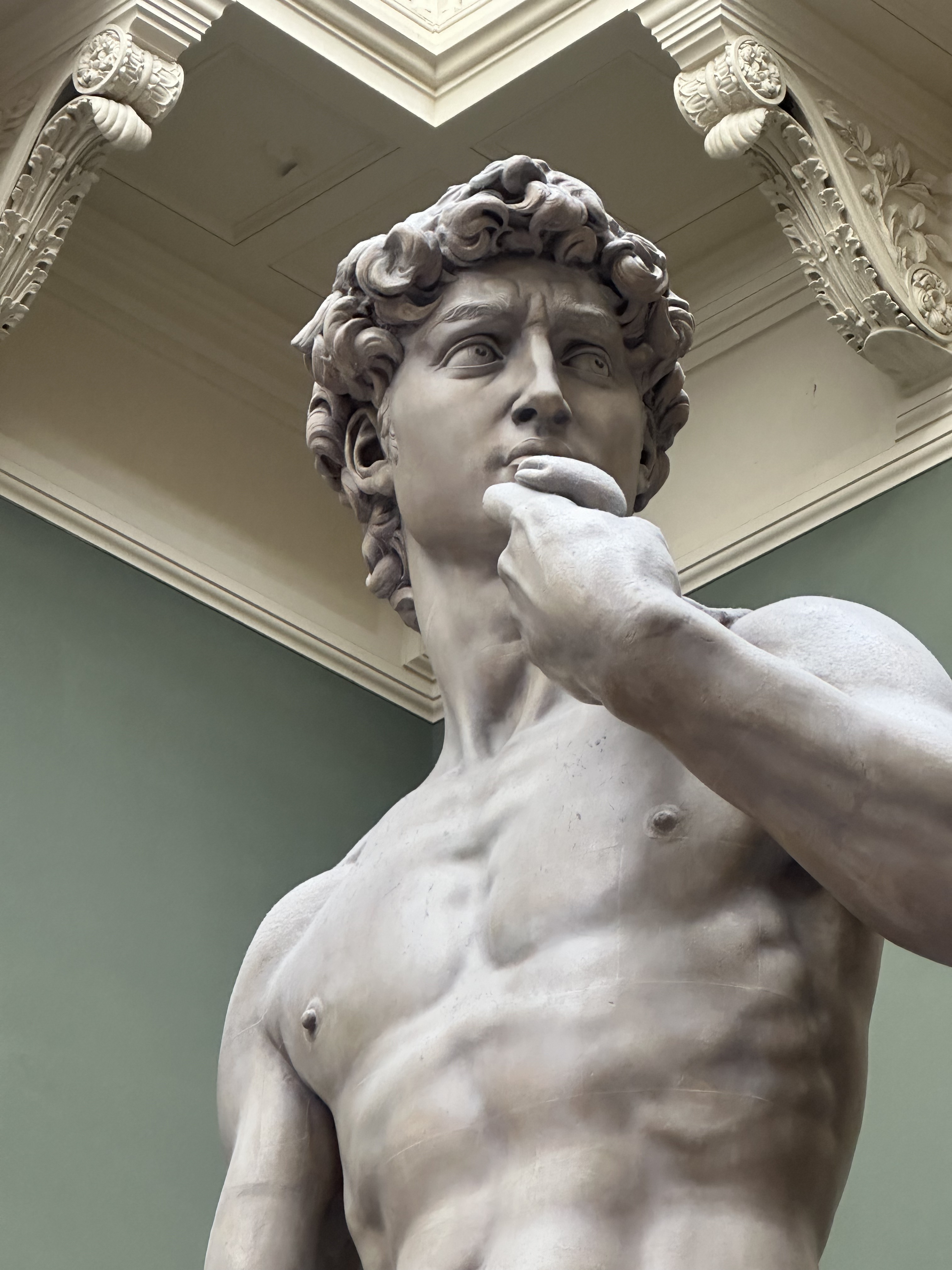
Michelangelo’s David at the V&A by @yellywelly

If they choose to not see you for who you are, what your capabilities are, where your heart is, how you move in the world, that is on them. Whether they consciously choose to miss out on really knowing who you are as a person or they just walk past you, that is them missing out.

The harsh truth is that validation is a real human need. Because validation provides a human connection: the validation provides feedback that contributes to growth and development. The validation also provides a sense of trust because someone sees us. This same validation also provides a sense of safety: because we are seen, heard and accepted, we feel that we belong, we fit in, and that belongingness makes us feel safe.

But we need to remember that needing validation does not mean we have to hunt or chase for it externally — not all the time. It is a yardstick to measure against, but not to base our net worth on. External validation is superficial, fleeting, and variable. It changes like weather and climate – dependent on time and location. If you base your self-worth on how others see you, this will lead to heartbreak, stress, anxiety, and a need for so much therapy!

We have control of how we view ourselves. Our valuation has to start with us. We need to establish our own value, independent of how others perceive us. We need to believe in ourselves first. That self-trust, self-reliance, and self-awareness will make us strong and less vulnerable to outside judgment.

It is easier said than done. But the path to healing, self-awareness, and self-love is never easy or straightforward. We just need to keep going, guided by love and kindness.

Yelly Writes

The blurred lines of grief

A few weeks after my return from my mother’s memorial service, I met up with a few friends. I thought it would be a good experience to be around people. But one person kept asking me what happened on my trip, how I was feeling, if I was okay now, and if I could move on now. Up until that point, I thought I would be okay being around people. I wasn’t. I wanted to scream at this person, and I wanted to run away and cry.

I didn’t, of course. I am thankful I bit my tongue and prayed for my tongue to stick to the roof of my mouth so I wouldn’t say anything I couldn’t take back. I knew this person did not have the capacity to understand the depth and heft of my grief, because they hadn’t experienced the death of a parent, and really, because we all deal with situations differently. They were approaching me and my experience in the way they would if they were in the same situation. I behaved differently around this person after that. I didn’t feel like we were occupying the same spaces anymore. I know I may have judged too harshly after that experience, but I had to step away. I was too hurt. I don’t think they realised that they had wounded me so deeply. At the time, I didn’t have the capacity to explain what I was going through (that’s on me completely), but I knew that if I had opened my mouth, I would be caustic and say things I couldn’t take back.

Grieving and healing are both processes that involve ebbs and flows, with twists and turns. I think boundaries are the same. They shift and stretch depending on a person’s growth and capacity

Everything is a work in progress.

Yelly Writes

No is a complete sentence

@yellywelly

I’ve been in so many situations where I’ve felt that I had to explain myself, whether I felt compelled to or whether I was made to, I’ve found myself defending my decisions. It has been an automatic response and I always thought it was because, growing up, I was being taught accountability. Because when asked, I (was made to believe) had to be able to explain myself, I had to be able to articulate my answers to why questions. I’ve always joked that I had an overdeveloped sense of responsibility and I know inside me there’s this little girl still deathly afraid of disappointing people.

As I’ve been going through this healing journey, I’m starting to learn that apart from the fight or flight response that humans have, trauma survivors have a freeze or fawn response. The trauma is something else to unpack entirely and I’m not laying blame on anyone. I know I need to deal with it eventually. But I don’t think that day is today. I do understand and recognise that I fawn more than I freeze. I think I understood early on in my life that I needed to be hyper-compliant and that I had to learn to how to quickly soothe and please other people to diffuse potentially volatile situations, avoid conflicts and be safe. Part of this was me explaining my decisions, justifying my actions and answering the why questions to appeal to reason. I somehow believed that it was my responsibility to do that.

Sometimes you don’t necessarily owe anyone else an explanation because it doesn’t matter if you have a perfectly good reason for your decisions. And, sometimes you don’t have to say anything more than no. No is sometimes the only thing you have to say because it’s a complete sentence. You don’t have to explain why your boundary is where it is. They won’t necessarily explain themselves to you. So let them set that boundary, and you can also act accordingly.

Yelly Writes

The art of not chasing

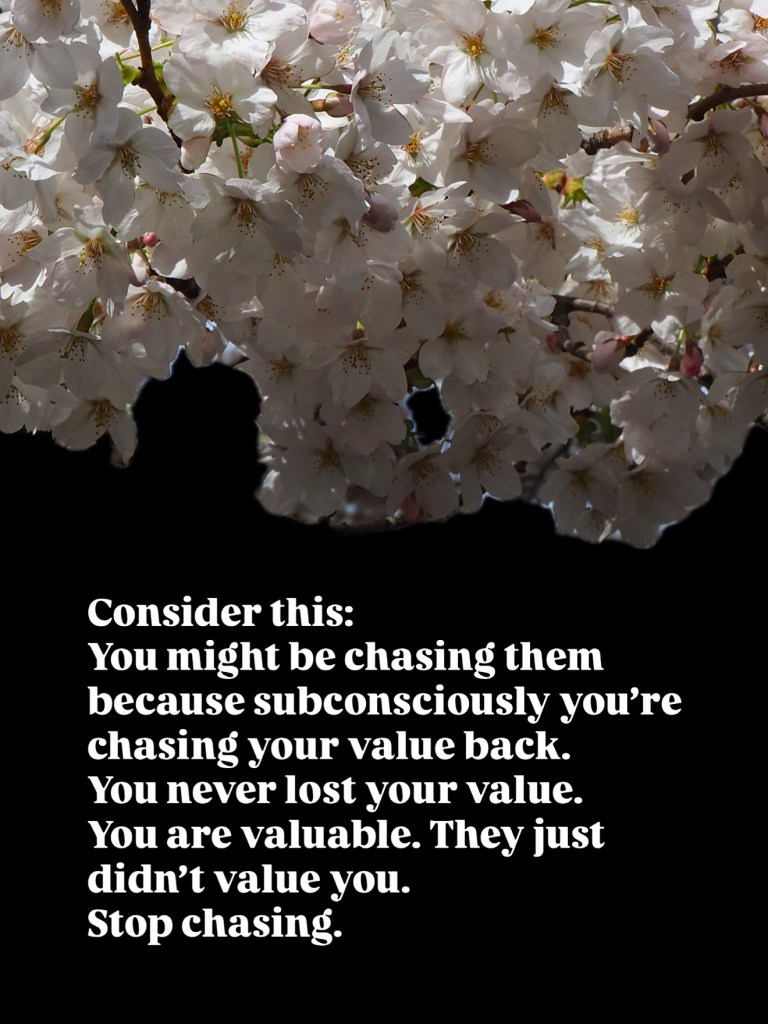
Sometimes you have to decide to just stop. Stop being available. Stop being considerate. Stop initiating. Stop chasing. Remember not everyone is for you and you are not for everyone. If they want to leave, let them.

Yelly Writes

Love is in the small things

Love and its expressions are so individual. Some use words. Some use action. It is as individual and unique as the person expressing it. There are different depths, different intensities, different levels, different kinds of love.

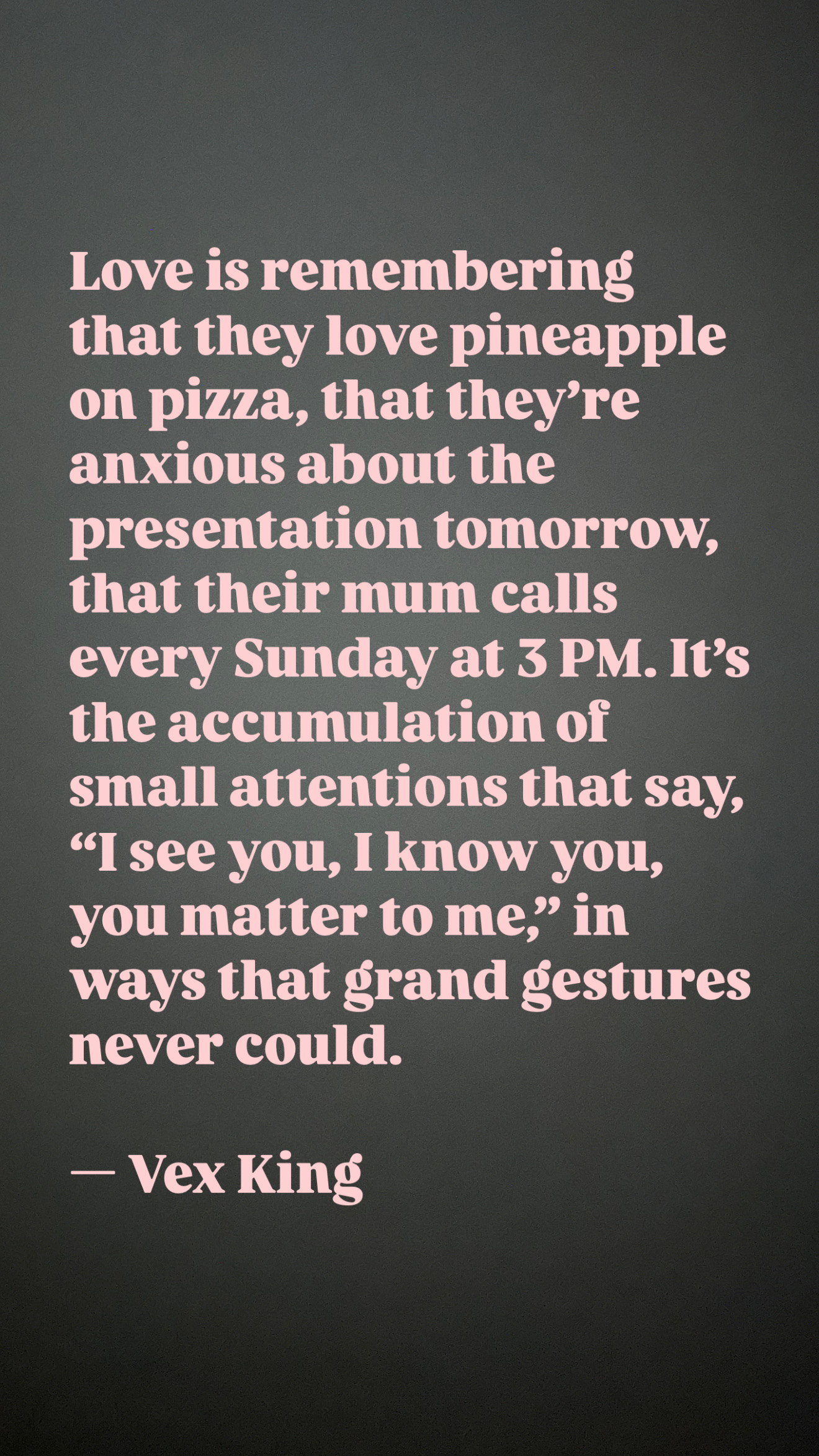
I’ve come to realise that love is in the small things. It’s in the way they say I’m thinking of you without saying it out loud. It’s in the small considerations. It’s in the small inconveniences they allow because you matter more to them than the disregulation they’ll feel. It’s in the small, fleeting touches, the side looks, in the involuntary smiles. It’s in the way they let you see them and their vulnerabilities. It’s in the small but dependable, almost habitual consistency. It’s how they are present for you, and not just by being there physically.

I am not, by any means, discounting the showy outpouring expressions of love. Yes, love is also in the grand gestures, in the wonderful, audible proclamations, the generous gift-giving, and the opening-of-the-floodgates intensity of expression. While the out-loud expressions can be performative because of societal expectations, there are the small, telltale signs that there was thought in the actions, and that you were the sole focus of the action.

When you are truly loved, you know. You feel it.

Love begets love. You need to trust that it does. Because it will.

Yelly Writes

The True Love Test

So I watched The Life List on Netflix again, and, of course, I bawled like a baby! I promise no spoilers, especially if you haven’t seen it. It’s the kind of girly romance movie that presents an idealized, pre-packaged view of love and romantic relationships. I’m not a cynic, not by a long shot (I’ve read too many Julia Quinn novels several times over to be jaded), to be cynical about love, even after the implosion of a relationship that I thought would last forever. I do sometimes smirk at the sugar coma sweetness of the Hallmark Channel formula movies. But the “true love test” in the movie had me thinking. In the film, it said that if you could answer yes to each of the 4 questions below, it was TRUE LOVE. 

1  Are they kind?

2 Can you tell them everything that’s in your heart?

3 Do they help you become the best version of yourself? 

4 Can you imagine them as the father/mother of your children? 

The questions make me smile. Because I can hear myself saying to someone at 25, “Love isn’t just a feeling, it’s a decision.” and seeing their look of confusion (in hindsight, that should’ve been a red flag, but I ignored it) and me patiently explaining what I meant.

Love is a decision. It’s a commitment. Because you decide, for better or for worse (whether it involves the permanency of marriage or not), to love this person, in the good and bad days, when tempers flare and patience wanes, when the sickness is disgusting, when the ick is hard to shift and when disagreements happen. It’s a commitment to stay and work things out, even when things get tough, damnedly uncomfortable and when they don’t particularly look rosy. It’s a promise to stay. It’s a vow to work on improving, changing for the better, and growing together. It’s saying “I got you” to this person and really having them, making sure they know you have them. It’s a pledge to stay accountable to this person. It is an unwritten but very binding contract to work through the warts, farts and smarts that come with adult relationships.

Being loved is an intrinsic need because it encapsulates affection, respect, acceptance, protection, and accountability. Every person has a deep-seated need for it, whether they care to admit it. Love isn’t easy but if you have it, wouldn’t you want to hold on to it, nurture it and cultivate it?

@yellywelly

Yelly Writes

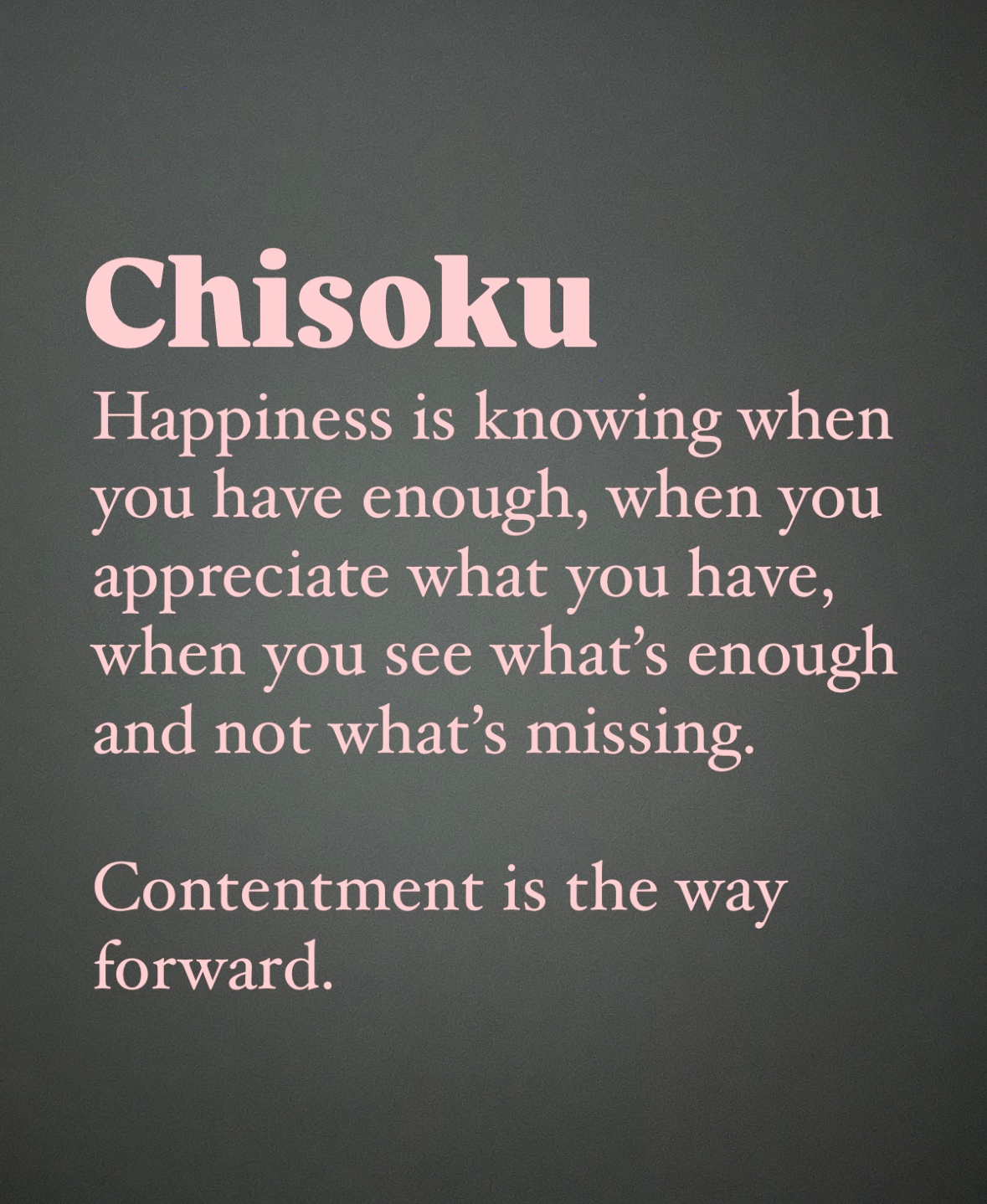
Protecting my sense of contentment

I know our relationships are meant to be safe spaces where we should be allowed to say anything we want, how we want to say things, when we want to say things. And for the most part, it’s true. Our relationships should offer us a place where we are able to express ourselves, where we can whinge and be brutally honest about how we feel.

I love a good whinge! It’s nice to be able to complain about something to someone and hear the agreement or the quiet chuckle because they get how we feel about something, someone, the state of the world and the lack of common sense in most things in general. There is a sense of validation in knowing that you’re not alone in feeling the way you do.

I am finding, lately, the constant whinge in some friendship circles to be fairly tiresome. I find myself rolling my eyes at yet again another statement about the stupidity of things or people, or gritting my teeth at a negative slant in expressing an opinion about something. I’m not surprised though, because life in general has been difficult and with the general state of things everywhere, it can be difficult to make like the Monty Python boys and look at the bright side of life. I get that completely. It’s just that sometimes, I wonder, is it really THAT bad ALL the time?

I also get that most people aren’t aware of the negativity in how they structure their statements (both written and verbal) and in their communication style. I understand that is a “them” issue and not a me issue. It is a them outlook problem and not a me outlook problem. I have, hopefully, in the past expressed the desire to look at the positive angle in things, hopefully repeatedly, and whether or not that is noticed or acknowledged is again a “them” issue.

I have always tried to be balanced in terms of my view in life – there is a positive and there is a negative. Life can be difficult and unfair sometimes, but I have always had the desire to look on the flipside. Because, while life is difficult, there are small pockets of joy. These moments of light allow us to appreciate what we have and not what is missing. When we focus on what we have, and not what’s missing, then we feel contentment.

Lately, despite adversity, I’ve found contentment to be the best way forward. It’s not denying how bad things are, it’s just appreciating that despite the bad things that have happened, there is still a lot of good.

I have promised myself to protect this sense of contentment – to the extent of allowing myself to cull certain elements of conversation, limit reactions and interactions in certain relationships. I get that these are just speaking out, and letting off steam. I get that. In the same vein, I do not want to be exposed to negativity. In the same way that these people are letting off steam so that they protect their equilibrium, I am also limiting my exposure to the noxious fumes of negativity that endanger my own equilibrium. We all have to do what we can to survive this jungle!

Yelly Writes

I NOW know you couldn’t

An open letter…to someone who probably won’t ever have the opportunity, or, if I’m honest, the desire, to read anything I write. But I just to say this.

I’m here. I love you. I don’t care if you need to stay up crying all night long, I will stay with you. If you need the medication again, go ahead and take it—I will love you through that, as well. If you don’t need the medication, I will love you, too. There’s nothing you can ever do to lose my love. I will protect you until you die, and after your death I will still protect you. I am stronger than Depression and I am braver than Loneliness and nothing will ever exhaust me.
― Elizabeth Gilbert

Yelly Writes

If I knew the difference then…

They always say that hindsight is 20/20 and I’m finding this so true these days.

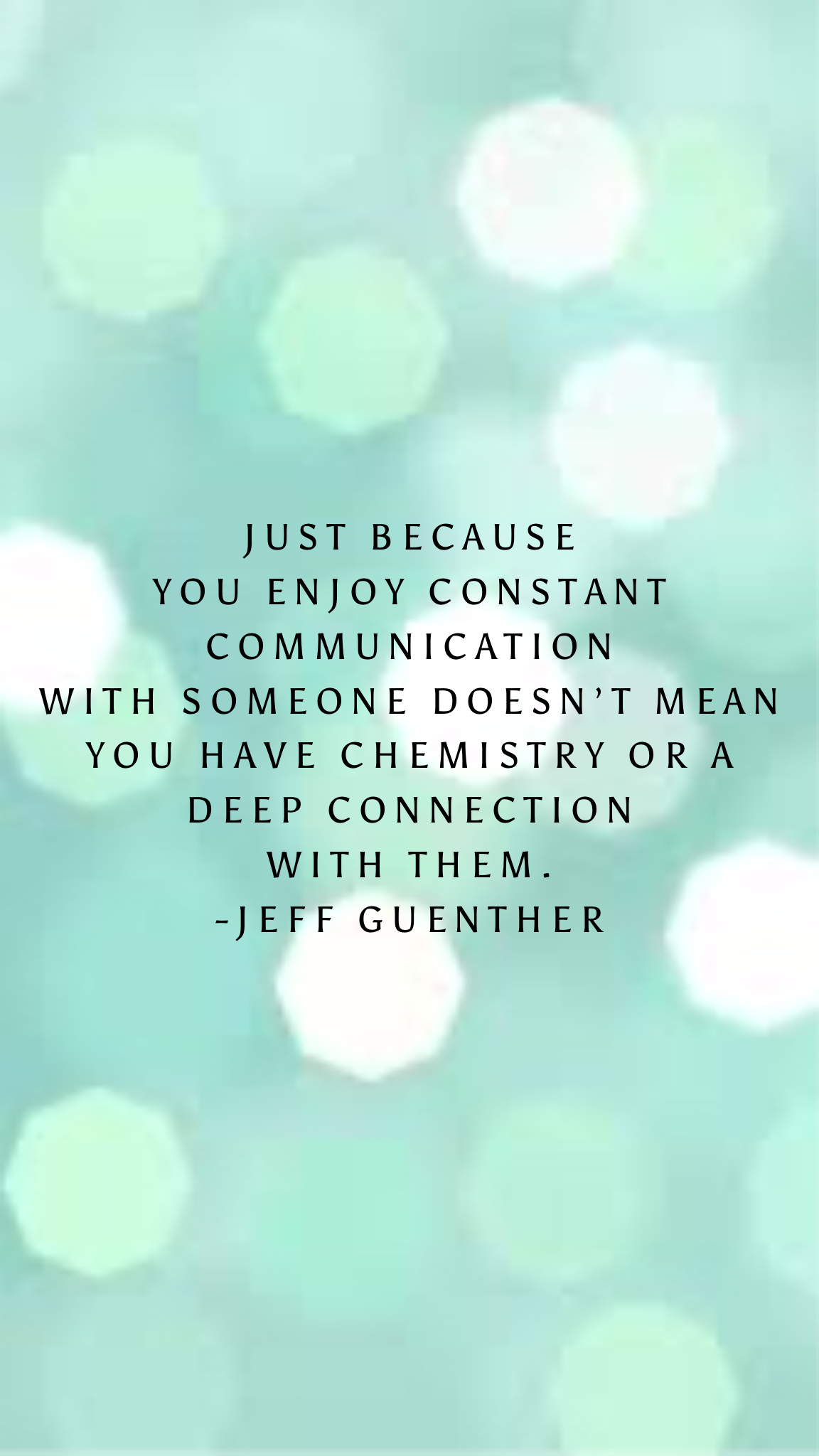
@TherapyJeff or Jeff Guenther is a licensed therapist who I follow on Instagram and he has so nuggets of wisdom that I’ve filed away over the years. But this was from a reel that I saw today and I thought I’d share it. it resonated a lot and now that I think about, if I’d heard this then, I would’ve saved myself more than 20 years of off-and-on heartache!